Home
American Architecture
Dictionary
Exterior Trim
Gingerbread
the Craft Gallery
Woodworking tips
Gazebos
Why Choose Wood
Garden Gates
Exterior Lighting
A Craftsman's blog
Fireplace mantels
Interesting
Great Links
Suggestions
About us
Resources
Hello!

XML RSS
Add to My Yahoo!
Add to My MSN
Add to Google


The ArchitecturalDictionary


Receive $10 off your purchase of $100 or more at acehardware.com until 06.30.08.


I believe you'll find the ArchitecturalDictionary helpful for finding definitions and pictures related to architecture and building design.
Need more help? Please use the suggestion page and send your questions and I'll be glad to help find your answer or use the Google search box.
Custom Search


A B C D E F G
H I J K L M N
O P Q R S T U
V W X Y Z

A
The architecturaldictionary

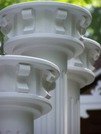
Abacus - a square or shaped block that helps support the entablature.
The architecturaldictionary

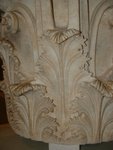
Acanthus leaf - admired by the Greeks and Romans for the elegance of its leaves. Found on many classical designs such as the Corinthian and Composite columns
Acanthus leaf The architecturaldictionary

ACROTERIUM - a ornamental small pedestal or block, used for statues or other ornaments, and placed on the apex and at the basal angles of a pediment.
ACROTERIUM The architecturaldictionary

Adamesque - The Adam style (or Adamesque) is a style of neoclassical architecture and design as practised by Scottish architect Robert Adam (1728- 1792) and his brothers. The "Adam style" is identified with: Roman style decorative motifs such as framed medallions, vases, urns and tripods, arabesque vine scrolls, sphinxes and gryphons. Flat grotesque panels Pilasters Painted ornaments such as swags and ribbons Complex color schemes
The architecturaldictionary

amorino - found in Italian Renaissance art an amorino ("little love") is another name for a 'putto'.
The putto is a figure of a pudgy human baby, almost always male, often naked and having wings. click to enlargeamorino-Triumph of Galatea, by Raffael

Anchor Bolt - A bolt or threaded rod used to secure the sill to the foundation wall.

Angel-lights - the upper panes of glass or "lights'" in a curved window frame, next to the springing.

Annulets - A ringlike molding underneath the capital of a pillar. There may be more than one.They are also called fillets or listels.

Antebellum is not a particular house style. Rather, it is a time and place in history. The features we associate with Antebellum architecture were introduced to the American South by Anglo-Americans who moved into the area after the Louisiana Purchase in 1803.

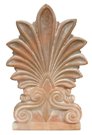
Ante-fixae - Vertical blocks which terminate the covering tiles of the roof of a Roman, Etruscan, or Greek temple; as spaced they take the place of the cymatium and form a cresting along the sides of the temple. The face of the ante-fixae was richly carved with the anthemion (palmette) ornament. click to enlargeAnte-fixae

arabesque - geometric intricate surface decoration; no human figures; has interlaced patterns. The arabesque is an elaborative application of repeating geometric forms that often echo the forms of plants and animals.click to enlargearabesque

ARCHITECTURAL PATTERN BOOKS-In the 18th and 19th centuries a flood of pattern books were published in Great Britain and the United States. Authors freely borrowed ideas and information. Advice on Classicism, draughtsmanship and construction were included in these pattern books. Architects, as well as master carpenters and masons, acquired these books to educate themselves and glean design ideas. Clients used these books as design help.
 
 
The architecturaldictionary

Architectonics- Architectonic is used to describe the art and science of building and construction. It refers to the sensibility to form and design, particularly to the preference of the simple over the complex, and the well-built over the mass-produced. Today, the word is used in a semiotic sense to refer to the use of parts as expressive signs that constitute the language system of the building.
The architecturaldictionary

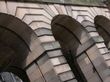
archivolt-an ornamental molding or band following the curve of the underside of an arch. click to enlargearchivolt moldings
The architecturaldictionary

Arris -an architectural term that describes the sharp edge formed by the intersection of two surfaces, such as the exterior corner of a masonry wall or the interior intersection of wall or wall/ceiling corner, or any intersection of architectural details. Also the raised edges which separate the flutings in a Doric column.

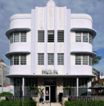
Art Deco - popular in the 1920s-30s,Art Deco was purely decorative. At the time, this style was seen as elegant, functional, and ultra modern. click to enlargeArt Deco architecture
 
 
The architecturaldictionary

Articulation - the manner or method of jointing parts such that each part is clear and distinct in relation to the others, even though joined.

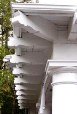
Arts and Crafts style - a movement protesting industrialization and edifying custom design and build. Arts and Crafts design extended rom the lanscape, to house design, and furnishings.click to enlarge Arts and Crafts exposed rafter tails
 
 
The architecturaldictionary

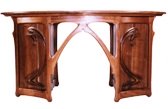
Art Nouveau -A style that encompassed art, architecture, and design. Popular from 1880-1914. It is characterised by highly-stylised, flowing, curvilinear designs often incorporating floral and other plant-inspired motifs.click to enlargeDesk by William Doub, New Hampshire

Ashlar masonary - Ashlar Masonry is usually done with squared (quarry cut) stone. Although the height and width of the stone will vary, the mason lays stone of equal height but unequal length in regular courses. Each course may use stones of a different height, but all stones in one course have about the same height. A Random Ashlar Pattern is a type of ashlar construction where the building blocks are laid apparently at random, but usually are placed in a definite pattern which is repeated again and again. There are no regular courses of one height. Stones of different heights and lengths are laid next to each other.
 
 
The architecturaldictionary

Astragal — semi-circular molding attached to one of a pair of doors to cover the air gap where the doors meet.

Atrium - A usually skylighted central area, often containing plants, in some modern buildings, especially of a public or commercial nature.

Attic Base - the term given in architecture to the base of Roman Ionic order columns, consisting of an upper and lower torus, separated by a scotia (hollow concave molding) and fillets. Click to enlarge imageAn attic base on the Roman Ionic column
The architecturaldictionary


B
The architecturaldictionary

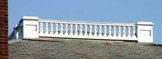
Balustrade The architecturaldictionary

Bandelet — Any little band or flat molding, which crowns a Doric architrave.
 
 
The architecturaldictionary

Bannister

bargeboards - Decorative boards fastened to the projecting gables of a roof.
bargeboards

Baroque- a post-Renaissance style started in Italy and Spain, popular in Europe in the 1600s - 1750s. Baroque means “irregular, contorted, grotesque”. A time of grand scale where everything was grandeous and highly ornamented. The Rococo Period reflects style in its most extreme.
The architecturaldictionary

Barrel Tiles - Rounded clay roof tiles most often used on Spanish-style houses.
The architecturaldictionary

Barrel Vault - A tunnel like hall created by building a long series of arches. Barrel Vault

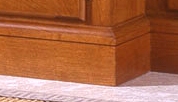
Baseboard - Also called "base molding" or "skirtboard" — used at the junction of an interior wall and floor to protect the wall from impacts.
The architecturaldictionary

Bas-relief Bas-relief, or low relief, is a method of sculpting which entails carving or etching away the surface of a flat piece of stone or metal creating a sculpture portrayed as a picture. Click to enlarge imageFrieze on an entabulature
The architecturaldictionary

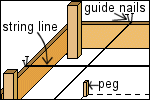
Batter Boards - Boards erected at the corners of a proposed building to specifically locate and show corners and show foundation wall height. batter boards

Bauhaus – A style of architecture that reflected the push towards functionalism and industrial design.
The architecturaldictionary

Batten — a symmetrical molding that is placed across a joint where two parallel panels or boards meet

battered chimney - a brick or masonry chimney with sides that are graduated so that its rectangular shape is wider at the bottom than the top.
Battered base, Battered plinth: The projection at the base of a wall which sloped outwards. Also known as battering.
The architecturaldictionary

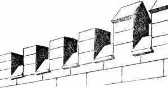
Battlements - in defensive architecture such as that of city walls or castles in which portions have been cut out at intervals to allow the discharge of arrows or other missiles.
battelment

Bearing partition - An interior wall supporting weight from above.
The architecturaldictionary

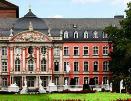
Baroque architecture - Emphasis was placed on bold massing, colonnades, domes, light-and-shade, color effects, and volume. Voluminous Baroque interiors allowed for monumental staircases that had no parallel in previous architecture. Another Baroque innovation was the state apartment, a sequence of increasingly rich interiors that culminated in a presence chamber or throne room or a state bedroom. Click to enlarge imageCastle of Trier (Germany)

Beak — Small fillet molding left on the edge of a larmier, which forms a canal, and makes a kind of pendant.
The architecturaldictionary

Beaux Arts - An American Renaissance period which ran from 1885 to the 1920s. Ornament and facades were featured in limestone, buff-colored or yellow brick, and accented with enormous cartouches and sculptural ornamental works.The World's Columbian Exposition of 1893 in Chicago was a showcase of Beaux arts. The style emphasized classical (Greek) forms and styles, elaborate detailing, massive plans, heavy masonry. Mostly used for grand public and institutional buildings, and the private homes of America's industrial barons.
The architecturaldictionary

Bed-mould -Any single or combination of mouldings under the projecting part of a cornice.
The architecturaldictionary

BELLCAST -an eave or roof that flares out like the flare of a bell.

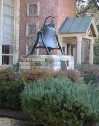
bellcot - a small framework and shelter for one or more bells, supported on brackets projecting from a wall or built on the roof of chapels or churches which have no towers. Some Bellcots are freestanding.
bellcot

BELT COURSE - decorative horizontal band on building, usually composed of projecting and/or contrasting stone or brick.

Belvedere -Belle vedere means beautiful view in Italian. A belvedere is an architectural feature on a roof, in a garden, or on a terrace, that affords a beautiful view.
belvedere

Bionic architecture - a movement for the design and construction of expressive buildings whose layout and lines borrow from natural forms.

Blobitecture - or blob architecture is a term for a current movement in architecture in which buildings have an organic, amoeba-shaped, bulging form.

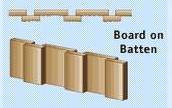
Board and Batten - Vertical wood siding where wood strips (battens) overlay and hide the open seams where the wall boards are joined. board and batten

Bolection - A moulding which projects beyond the face of a panel or frame. The molding used to trim panels in doors, wainscot, or any other frame panel situation. Particularly used to describe fireplace moldings.

Boss – a knob or protrusion of stone or wood.
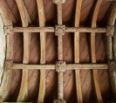
One common example of a boss can be found in the ceilings of buildings and particularly at the intersection of a vault. In Gothic architecture ceiling bosses were often carved with foliage, heraldic devices, animals, birds, human figures or faces. Click to enlarge imageBoss

Bowtell – a medieval term in architecture for a round or corniced molding below the abacus in a Tuscan or Roman Doric capital. A roving bowtell is one which passes up the side of a bench end and round a finial, the term roving being applied to that which follows the line of a curve.
Also Boultel- a molding, the convexity of which is one fourth of a circle, being a member just below the abacus in the Tuscan and Roman Doric capital; a torus; an ovolo.

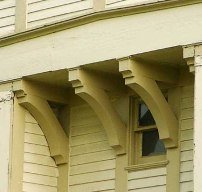
Bracket - ornamental support for roof cornice, or arch or entablature.Bracket
The architecturaldictionary

Brick Expressionism - a variant of expressionist architecture using rough, angular or pointy elements. Primarily used in Germany in the 1920s using bricks, tiles or clinker bricks as the main visible building material.
Architectural expressionism was a concurrent developement of Bauhaus architecture and a variant called the "New Objectivity". But where Bauhaus architects argued for the removal of all decorative elements, expressionist architects developed a distinctive form or ornamentation. Click to enlarge imageBrick Expressionism
The architecturaldictionary

Brick nog –a construction technique in which bricks are used to infill the vacancies in a timber framed home. then may be covered with tile, weatherboards or rendered. Brick noggings were often used as a replacement infil and often causes a problem by distorting the frame and trapping rainwater causing the rotting of timbers. Click to enlarge imageBrick nog
The architecturaldictionary

Bridging - Wood or metal strips nailed diagonally between floor joists. Prevents squeaking of floors. Bridging

Brutalism – This style began in England and flourished from the 1950s to the 1970s.
Brutalism nearly always used exposed concrete, usually are formed with repetitive angular geometries, and often revealing the textures of the wooden forms used to shape the material. Click to enlarge imageBrutalisim architecture

Bullseye window An oval window set horizontally set horizonally as a dormer.

Bungalow - A bungalow is of the Craftsman period of design.It is one or one-and-one-half stories high-low to the ground in appearance- has a rectangular or square shape- has deep roof overhangs and wide eaves- has a porch across the front- is integrated with natural materials, colors and forms.

BUTTRESS-a vertical structure of heavy masonry or wood applied as reinforcement to the wall of a building. Can serve a structural or decorative purpose.
buttress


C
The architecturaldictionary

Cabled fluting — Convex circular molding sunk in the concave fluting of a classic column, and rising about one-third of the height of the shaft.
The architecturaldictionary

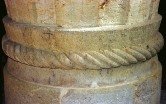
Cable rope - A carved molding in stone or wood that looks like rope. Cable rope molding

calendar house - A calendar house symbolically represents the numbers of days in a week, and weeks and months in a year with architectural elements.
These are very rare. The Knole home, built between 1456 and 1486, situated close to Sevenoaks in north-west Kent, is reputed to be a calendar house, having 365 rooms, 52 staircases and 7 courtyards.
The architecturaldictionary

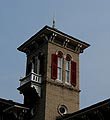
CAMPANILE- Bell tower originating in Italy and and developed into the tower section of the Italianate style. Favoured in Canadian villas in the mid 19th century.Italinate campanile

Cantilever- Cantilever construction allows for long structures without external bracing. Such as second story porchs, decks, even rooms. cantilever
The architecturaldictionary

CAPITAL- the decorative head of a vertical support such as a column or pilaster.
capital


carcase floor-a regional term and perhaps unique to Virginia was the framing of the great-room floor, which had girders running from north to south, with smaller perpendicular members above and below them.
The architecturaldictionary

Cartouche- a cartouche is an oblong enclosure with a horizontal line at one end, indicating that the text enclosed is a royal name.In heraldry, an oval-shaped shield, used to display the arms of women as an alternative to the lozenge. It is also often used for the arms of clergy who wish to avoid the military implications of the escutcheon.

Casement Window- A window that opens by swinging inward or outward much like a door. Casement windows are usually rectangular with the height being greater than the width. Casements were made popular in the arts and crafts movement and used extensively in Frank Loyd Wright designs. Thet are often grouped in ribbon bands bands. casement window
The architecturaldictionary

Cathedral - The term cathedral refers to the function of a church, not its architectural style. A cathedral is a church that serves as a bishop’s headquarters, so to speak. It’s called a cathedral because it contains his cathedra (chair). The city in which the cathedral is located is the bishop’s see. In this usage, the word see comes from a Latin word meaning seat. The city is the bishop’s see in the sense that a city might be the seat of government.

Cavetto -a concave, quarter-round molding. Cavetto molding
The architecturaldictionary

cement board- A concrete board that is placed on a subsurface such as bathroom and kitchen counters and backslashes. Tile or aother finished materials are then glued or mortered to it. Cement board resists shifting and is impervious to water.
The architecturaldictionary

Chair rail- A wooden molding placed horizontally on a wall to prevent chairs from damaging the wall. Typically used as a decorative effect on a wall to divide a painted lower section from a wallpapered upper section. Chair rail

CHIMNEY STACK- the structure in stone. block, or brick, containing flues and rising above the roof.

Chin-beak — Concave quarter-round molding. There are few examples of this in ancient buildings, but is common in more recent times.
The architecturaldictionary

cinquefoil- - in tracery, having five pendants in a circular ring; usually applied to windows and panels. quatrafoil - tracery constructed from four foils. trifoil - tracery in three foils.Corbelcinquefoil tracery

Cladding- The outer skin of a building. A term used to describe the siding or materials covering the exterior of a building.
The architecturaldictionary

Clapboard-Also known as bevel siding or lap siding. Clapboards are particularly characteristic of the United States, having been steadily used since the earliest years of the colonial settlements. Each clapboard overlaps the one below it, usually leaving 4-7 inches exposed to the weather. White pine is considered the best wood for clapboards; cedar, cypress, and spruce are also used.
The architecturaldictionary

Classical order- A classical order is one of the ancient styles of building design quickly recognizable by the type of column and capital employed. There are five recognized orders.

Clerestory-An upper portion of a wall containing windows for supplying natural light to a building.

classic column- The Maison Carrée at Nîmes in southern France, is one of the best preserved temples to be found anywhere in the territory of the former Roman Empire. six Corinthian columns.
The architecturaldictionary

Chamfer- A beveled edge usually at 45 degree to the face.

Chatri- A domed pavilion supported by columns at each corner Chatri
The architecturaldictionary

CHIMNEY-PIECE -A mantelpiece, usually of wood or marble, that surrounds the sides and top of a fireplace opening. click on imageCHIMNEY-PIECE

Cloud lift-A decorative motif developed and used extensively by Greene and Greene. Cloud lift
The architecturaldictionary

Cloister- A covered walk with an open colonnade on one side, running along the walls of buildings that face a quadrangle.

Coffer- A rectangular or square recessed area in a ceiling. Sometimes these emphasize the roof beams; other times they are carved, molded, or ornately decorated.cofferef ceiling

Collar Beam- a horizontal piece of timber connecting and tying together two opposite rafters. Commonly used as a ceiling joist. Collar Beam
The architecturaldictionary

COLONNADE-a row of columns usually supporting the base of the roof structure Collonnade

column-A supporting pillar consisting of a base, a cylindrical shaft, and a capital.There are three basic column styles for single-family homes, derived from ancient Greek architecture. The Doric column Doric is the oldest and simplest Greek style--its found on the Parthenon in Athens. This column features fluted sides, a smooth rounded top, or capital, and no separate base.Ionic columns are identified by the scroll-shaped ornaments at the capital, which resemble a ram’s horns.
The IonicIonic column rests on a rounded base.Corinthian columns are the latest of the three Greek styles and show the influence of Egyptian columns in their capitals, which are shaped like inverted bells. Capitals are also decorated with olive, laurel, or acanthus leaves.
Corinthian corinthiancolumns rest on a base similar to that of the Ionic style
The architecturaldictionary

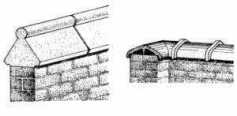
Coping- A flat cover of stone or brick that protects the top of a wall
coping

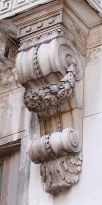
Corbel - a piece of stone jutting out of a wall to carry weight. A piece of timber projecting in the same way was called a "tassel" or a "bragger". The technique of corbelling, where rows of corbels support a projecting wall or parapet, is common in all cultures.
CorbelCorbel
The architecturaldictionary

Cornice- Any crowning projection, interior or exterior.A molding at the corner between the ceiling and the top of a wall.

Cove molding or Coving— a concave-profile molding that is used at the junction of an interior wall and ceiling.
The architecturaldictionary

CRACKLING - A painted finishing technique. Creates an aged effect.

Crocket - an architectural ornament, usually in the form of a cusp or curling leaf, used at the edge of a spire, pinnacles and gables.
crown molding

Cresting - an ornamental iron work at the top of a house, cupola, or dormer
click to enlargeCresting

Crown molding- To form the crown, top, or chief ornament of. Crown molding is typically applied along the seams where a ceiling meets wall. It includes a large family of moldings which are designed to gracefully flare out to a finished top edge; generally used for capping walls, pilasters, cabinets; used extensively in the creation of interior and exterior cornice assemblies and door and window hoods.
crown molding

Cross Gable- Two perpendicular gable roofs
cross gable

CUPOLA- small structure on top of a roof or dome, sometimes with windows, sometimes with horizontal shutter lattice and used as a vent.
cupola

Cyma- molding of double curvature, combining the convex ovolo and concave cavetto. When the concave part is uppermost, it is called a cyma recta but if the convex portion is at the top, it is called a cyma reversa.


D
The architecturaldictionary

Deconstructivism- also Deconstruction, is an approach to building design that attempts to view architecture in bits and pieces. The basic elements of architecture are dismantled. Deconstructivist buildings may seem to have no visual logic. They may appear to be made up of unrelated, disharmonious abstract forms.

DECOUPAGE- Decoupage, derived from the French word decouper, meaning to cut out,is the creative art of pasting, assembling and varnishing paper cutouts for accenting objects.

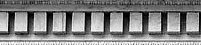
Dentil molding- A small rectangular block - a tooth-like cube -used in a series forming a molding Dentil molding

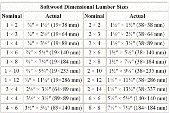
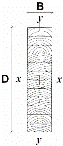
Dimensional lumber- Dimensional lumber is a term used for lumber that is finished/planed and cut to standardized width and depth specified in inches. Dimensional lumber is made from softwood is typically used for construction, while hardwood boards are more commonly used for making cabinets or furniture. Click to enlarge imagedimensional lumbar

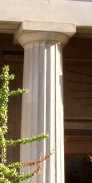
Doric - The earliest and simplest of the orders of architecture developed by the Greeks and iderntified by its columns and architrave. doric column

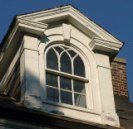
DORMER- A gabled, but sometimes a shedded projection extending from the slope of a roof. Usually has a window(s) and is usued to allow light to an attic or rooms. Dormer

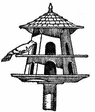
Dovecote- A compartmental structure, often raised on a pole, for housing domesticated pigeons.Dovecote

Drip moulding- a projecting moulding, usually above a window or door, that is designed to allow rainwater to "drip".

Dripstone- A projecting string, hood, or molding over doorways, arches, windows, and niches, first installed to direct rainwater away from the opening. Dripstones can be very ornate. Dripstone

Dutch Gable-American- In portions of the United States and in Australia, dutch gable refers to a type of roofline style used on ranch-style houses that is a hybrid between a gable roof and a hip roof. Click to enlargedutch gable

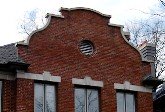
Dutch Gable-European- Dutch gable, has multiple meanings depending on the region and the portion of a structure it is referring to.In European architecture the Dutch gable, also known as a Flemish gable, acts as an ornamental pediment to a wing or other architectural feature such as a projection in the facade. Curved,stepped or often both the Dutch gable was a notable feature of the Renaissance architecture.Click to enlargeDutch Gable


Highland Hardware
Keywords:

Highland Woodworking
Probably the best Woodworking/Harware store there is!
Use the search box or
just click the advance search button.

E
The architecturaldictionary

EAVE- The underside of the roof overhang.
Conceptually it refers to the part of a sloping roof that overhangs the wall including the facia board(if any)and the soffit. Eave ie: craftsman bungalows have very wide eaves with decorative brackets.

Eastlake1879-1905 New England - a style of ornamentation using numerously variegated Victorian designs including stick work, spindles and knobs, brackets, sawn scroll work, “free classical” detailing, Gothic additions, finials, roof cresting, towers and cupolas, oxbow, any number of scalloped styled siding. Click to enlarge imageEastlake architecture

Echinus - The echinus lies atop the necking. It is a circular block that bulges outwards towards the top in order to support the abacus

egg n’ dart moulding- (also leaf and dart, also alpha and omega - beginning and end) Classical ornamental design that forms a course of alternating oval shapes and arrows. Click to enlarge imageegg n dart moulding

ELEVATION- A drawing or photograph that shows one face of a building. Click to enlarge imageelevation drawing

engaged column - a column embedded in a wall and partly projecting from the surface of the wall, sometimes defined as semi or three-quarter detached. Rarely found in classical Greek architecture but frequently in Roman architecture.
Engaged columns are distinct from pilasters, which are ornamental and not structural.

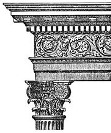
ENTABLATURE - a major element of classical architecture, the superstructure of moldings and bands which lies horizontally above the columns, resting on their capitals. The entabulature is commonly divided into the architrave—the supporting member carried from column to column, pier or wall immediately above; the frieze—an unmolded strip that may or may not be ornamented; and the cornice, the projecting member below the pediment. Entablature

entasis- slight convex curve applied to columns in Classical architecture to counter the illusion that would otherwise occur of the columns being slightly concave.

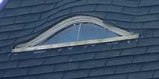
Eyebrow dormer - The common function of an eyebrow dormer is to admit light and air to an unfinished attic. Eyebrow Dormer

Eyebrow eave - On a shingled roof, an eave that is carried over a door entry in a wavy line very similar to the eyebrow dormer.

Expressionist architecture -paralleling the expressionist visual and performing arts during the first decades of the 20th century, expressionistic architecture is the concept of architecture as a work of art. Some of the qualities of the original movement are distortion, fragmentation or the communication of violent or overstressed emotion. These are communicated in architecture as unusual combinations of mass, angular definitions, and even polymorphic structure.

The architecturaldictionary

F

Facia- The horizontal board that covers the end cuts of the rafters and which is overlapped buy the roofing. The board to which guttering is fitted. Fascia is a term which generally describes any vertical surface which spans across the top of columns or across the top of a wall. Facia

FENESTRATION- The arrangement of windows.

Finial- a vertical ornament usually applied to the peak of dormer The finial is an architectural ornament used to emphasise the apex of a gable. Smaller sized finials are used as a decorative ornament on the ends of curtain rods or applied to chairs and furniture. Frequently used on top of bed posts or clocks. Finial

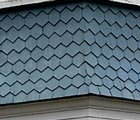
Fish Scale Shingles -On Victorian and Queen Anne buildings, fish scale shingles were used extensively as a finishing element. These are generally wood and are most frequently found on the gable or upper section of the buildings. fish scale shingles

Felt Paper - A black building paper used to cover roof boards and sheathing to help control moisture and wind infiltration. Also used to cover the subfloor before hardwood flooring.

Filligree- In architecture it may be said to consist of the art of curling, twisting, or creating the effect of the same, with wood in a decorative effect. Small and/or large beads or geometric shaped woods are often applied on the junctions, or at intervals at which they will set off the work effectively. The more delicate work is generally built in frameworks and used in interior archways as fretwork.

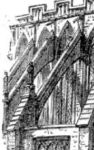
Flying buttress- a structural feature employed to transmit the thrust of a vault across an intervening space, such as an aisle, chapel or cloister, to a buttress built outside the latter. The employment of the flying buttress meant that the rules regarding load bearing walls could be expanded, thus allowing for great flexibility in design and purpose.
Flying Butress

Framing-The structural wooden or steel members, or the act of building, that provide structure and definition to a house or building.

Fractable-A decorated gable end carried above the roofline. A fractal is generally "a rough or fragmented geometric shape that can be subdivided in parts, each of which is approximately a reduced-size copy of the whole
Fractable

FRENCH WINDOW-A window that opens to the floor in two hinged parts.Click to enlarge imagefrench window

Fret-A wall or cornice decoration that is formed by small fillets intersecting each other at right angles.
Fret

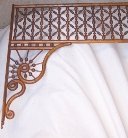
fretwork spandrels- Decorative pieces made with intricate cutwork and joined with Ball & Dowel or Spindle sections.
Fretwork spandrels

Ornate classical Frieze

FRONTISPIECE-The principal bay of a building. In architecture, a frontispiece constitutes the elements that frame and decorate the main, or front, door to a building; especially when the main entrance is the chief face of the building, rather than being kept behind columns or a portico.

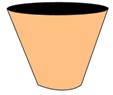
frustum- a truncated cone or pyramid; the part that is left when a cone or pyramid is cut by a plane parallel to the base and the apical part is removed.
The upper part of a Doric column. Frustum

G
The architecturaldictionary

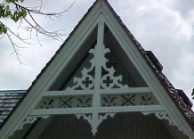
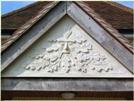
click to enlargeGable Decoration Gable decoration - Also know as Gingerbread it is the decorative woodwork applied under the eaves or at the bargeboard level at the apex of a gable end. Also refers to decorative bargeboards.

Gabled roof- Gable: That part of the wall immediately under the end of a pitched roof, cut into a triangular shape by the sloping sides of the roof A pitched roof having a gable at each end

GadrooningIt is derived from the French word 'godron', which means 'ruffle'.
In furniture and other interior accessories, the term applies to an ornamental carved band of tapered, curving and alternating concave and convex sections usually diverging from either side of a central point. often with rounded ends vaguely reminiscent of flower petals. It was widely used during the Italian Renaissance. gadrooning gadrooning
The architecturaldictionary

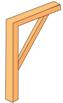
Gallows bracket- A rather simple bracing bracket that is quite commonly used. Gallows brace

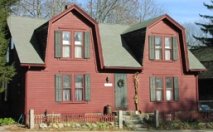
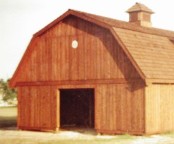
Gambrel- A roof where each side has two slopes; a steeper lower slope and a flatter upper one; a 'barn roof'. Often found in Colonial revival houses in the "Dutch" style.
double gambrel gambrel

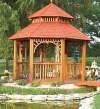
Gazebo - A small summerhouse or pavilion with a view, or a belvedere on the roof of a house.
GazeboGazebo

Georgian architecture-the architectural period between 1720 and 1840. It was concurrent with the British monarchs George I-IV, who reigned in continuous succession from August 1714 to June 1830.

gingerbread- a word to describe any kind of decoration on a home found in such places as the gables, vergeboards, porches, eaves, and around windows or doors. Made famous by the Victorian era.
gingerbread

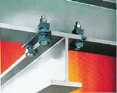
Girder - A strong, wooden or metal member spanning foundation walls designed to support joist ends. Steel girders often have an I beam cross section for strength. Girder is the term used to denote the main horizontal support of a structure and usually supports smaller beams.
GirderSteel girder

Gluelam beam - also called glue-laminated beams or Glulam, is a structural timber product composed of several layers of dimensioned lumber glued together. By laminating several smaller pieces of wood, a single large, strong, structural member can be manufactured from smaller timber. Laminated beams can be used as vertical columns, horizontal beams, or as often seen in contemporary churches, as arched ceiling beams. Click to enlarge imageGluelam beam

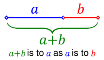
The Golden Ratio - In mathematics and the arts, two quantities are in the golden ratio if the ratio between the sum of those quantities and the larger one is the same as the ratio between the larger one and the smaller. The golden ratio is approximately 1.6. Click to enlarge imageGolden Ratio

Gothic Revival - The style that was the beginning of the Victorian Age. The elements are based on architectural ideas from the Middle Ages and was popular in the 1830s and 40s. Gothic Revival buildings a featured pointed or lancet doorways and windows, spire, and vertical features. Click to enlarge imageGothic Revival

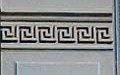
Greek key-A carved Classical geometric decoration resembling a maze, and repeated in bands. Composed of interlocking straight and right-angled lines it is a common decorative elements in Greek art and Roman art appearing on everything from pottery to tapasterys. The architectural decorations were used extensively on friezes. Although it is a conjecture it is thought that the patern symbolized infinity and unity. Click to enlarge imageGreek key

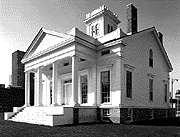
Greek Revival- an architectural movement of the late eighteenth and early nineteenth centuries. A phase of Neoclassicism that spread the idea of “noble simplicity and calm grandeur." The style was looked on as the expression of local nationalism and civic virtue. Greek revival

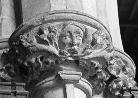
green man - an ancient symbol of man's deep connection to nature; a decorative Gothic carving characterized by a human face sprouting foliage. The Green Man motif has many different faces and variations and is found in many cultures around the world, Click to enlarge imageGreen man capital in an english church. Photo by Simon Garbutt

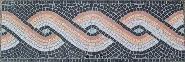
Guilloche- an architectural decoration formed by two interlaced wavy bands forming a pattern of circles or loops. This may be found in carved wood trim mold, tile and stone carvings. Click to enlarge imageguilloche

H
The architecturaldictionary

hammer-beam roof- a Gothic open timber roof, of which the finest example is that over Westminster Hall.
Hammerbeam

Hardboard- also called high-density fiberboard, is a type of fiberboard, which is an engineered wood panel. It is usually seen 1/8" - 1/4" thick. It is similar to particle board and medium-density fiberboard, but is much harder, denser, and heavier because it is made out of exploded, highly compressed wood fibers. It is usually called masonite because that was the first brand to be marketed in the U.S. It has no grain and little structural strength. It is usually used as a substrate to veneers, vinyl, amd laminate and in its thin width as backing for furniture and cabinetry. Click here to enlarge pictureHardboard

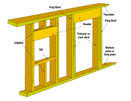
Header- a framing member crossing and supporting the ends of joists, studs, or rafters so as to transfer their weight to parallel joists, studs, or rafters. Found over doors and windows. header - a brick that is laid sideways at the top of a wall

Hearth- The floor of a fireplace, usually extending into a room and paved with brick, flagstone, or cement. HearthHearth

high-density polyurethane- rigid foam can be made with the use of specialty trimerization catalysts which create cyclic structures within the foam matrix, giving a harder, more thermally stable structure, designated as polyisocyanurate foams. Such properties are desired in rigid foam products used in the construction sector.(Wikipedia-Polyurethane)

Hipped roof- A roof with four sloped sides. A square hip roof is shaped like a pyramid. Often having dormers, they are commonly seen in bungalows and cottages, and the American Foursquare. Also known as a pavilion roof.Click to enlargeHipped roof

Hip rafter- The rafter extending from the wall plate to the ridge at the corners of a hip roof. Click to enlargeHip rafter framing

Hyphen - a connecting piece between two larger masses of a building. It's most commonly used when referring to Colonial-era houses - especially the Georgian style. The masses connected to the main house by the hyphens are called dependencies.
The architecturaldictionary

Inlay -in which the secondary material is sunk into portions of a solid ground cut out to receive it.
The architecturaldictionary

I
The architecturaldictionary

The architecturaldictionary
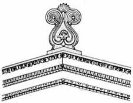
infill - any material used to fill a void in a structure. For ex. glass panels used as an infill between timber posts.
wattle and daub was probably the original infill.
Also used in Urbanism as the reclamation of unused land, particularly the reuse and redevelopment of low use property within an existing community or development.
The architecturaldictionary

Inglenook - A bench, especially either of two facing benches, placed in a nook or corner beside a fireplace.

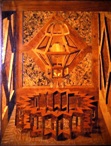
intarsia - Intarsia is a form of wood inlaying that is similar to marquetry. intarsia is created by selecting different types of wood for their natural grain patterns and colors to create the picture. Each piece of wood is then individually cut , shaped, and sanded.Click to enlarge imageItalian Renaissance
The architecturaldictionary
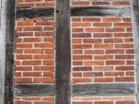
intercolumniation - in classical architecture, the clear space between the edges of two adjacent columns, as measured at the lower portion of their shafts. Intercolumniation is expressed in terms of the column diameter.
The architecturaldictionary
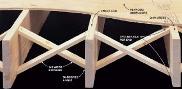
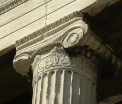
Ionic Order - The second of the three Greek architectural orders to be developed. Ionic columns are generally more tall and slender than those of the Doric. The spiral scrolls, or volutes, at either side of the cap run from front to rear, and an echinus molding with egg-and-dart ornamentation occupies the space between them. Ionic columns incorporate a column base, and volutes can be seen in their capitals. Ionic order column

Italian Renaissance - begining the opening phase of the Renaissance and popular in 1800s-1920s in America. This is a revival architecture inspired by the great Renaissance houses of Italy. Many of these design features were copied from actual Renaissance landmarks of Roman, Florentine, and Venetian pillazzis and villas, and then translated into American palaces, primarily in our cities. Click to enlarge imageItalian Renaissance

J
The architecturaldictionary
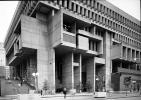
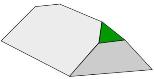
Jenkins-head roof - A gabled roof with its apex truncated by a small hipped roof.

Jenkins-head roof

Joist - A beam supporting a floor or ceiling. Wood framing members, usually set 16" apart on center, carefully chosen to support all "live" and "dead" loads. Click to enlarge imageJoist