Golden Ratio
The Golden Ratio is designated by the Greek letter ‘PHI’.
Its use is considered to create pleasing balance and symmetry in design.
The Golden Ratio and antiquity
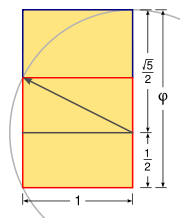
Since ancient days the golden ratio in the form of the golden rectangle has been used extensively.
The Greek sculptor Phidias, (ca. 490-430 BC), made extensive use of the golden ratio in his works.
The structures of the Roman classical era are said to be designed within the Golden Ratio. The Egyptians, who made extensive use of it in the building of temples and pyramids, called it the sacred ratio.
Beginning in the Renaissance, a body of literature on the aesthetics of the golden ratio developed. And as a result, architects, artists, book designers, and others have been encouraged to use the golden ratio in the dimensional relationships of their works.
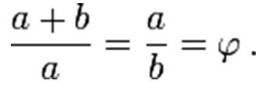
In mathematics and the architectural arts two quantities or lengths are in the golden ratio( φ)if the ratio between the sum of those quantities and the larger one is the same as the ratio between the larger one and the smaller.
For example – lets say that you like to build a picture frame.
You think that a frame 36”w and 24”h but you would like to apply the golden ratio to it.
The golden ratio says that the ratio of 36”(a, the larger) and 24”(b, the smaller),which is written 36/24, will need to be the same as the ratio of (36” + 24”) is to 36”, or 60/36.
This would be written 60/36 = 36/24. When we break these down to their lowest common denominator you get 5/3 = 3/2. Because the ratios do not equal each other the frame is not a golden rectangle.
In order to make the picture frame golden the ratio tells us a/b = a+b/a or 36/x = 36+x/36.
Nah-that’s not complicated.
Let’s use the short cuts-----------
The golden ratio is approximately 1.62. I’m assuming everyone understands that when a backslash is used in a formula the backslash means ‘divided by’.
So if the height is known use the formula Ht x 1.62 = W or 24”x 1.62 = 38.88”
The aforementioned frame will be golden if the width is 38.88” (38 7/8” is close enough.)
Double check by dividing the larger by the smaller. In this case 38.88 by 24 = 1.62 (golden)
If the width is known use the formula - W / 1.62 = H or 36” / 1.62 = 22.22”
The aforementioned frame will be golden if the height is 22.22” (22 ¼” is close enough.)
Double check by dividing the larger by the smaller. In this case 36 by 22.22 = 1.62 (golden)
The golden ratio has fascinated architects and intellectuals of diverse interests for at least 2,400 years. Biologists, artists, musicians, historians, architects, psychologists, and even mystics have pondered its use and appeal.
Fibonacci sequence
In 1202 Leonardo of Pisa, known as Fibonacci, published a sequence of numbers. This sequence has become known as the Fibonacci sequence-
0, 1, 1, 2, 3, 5, 8, 13, 21, 34, 55, 89, 144, 233, 377, 610, 987, 1597, 2584, 4181, 6765, 10946, 17711, 28657, 46368, 75025, 121393
Each number is the sum of the preceding two numbers. It is of note that from the number 5 and following the number divided by the preceding number equals 1.62. These numbers can be used as a shortcut for estimating sizes within the Golden Ratio. Let's go back to the picture frame.
We have an O.D. of 36”w x 22 ¼”h. for the frame, let’s figure the mirror size.
With the Fibonacci sequence we see that a mirror size of 34”w x 21”h will fall within the Golden Ratio. But it leaves us with 1” stiles and 2” top and bottom rails. Not so good.
So let’s assume we want a 2” frame. 36”o.d. – 4” = 32” mirror width.
Using the formula W / 1.62 = H we get a mirror height of 19 ¾”.
Double check by dividing the larger by the smaller. In this case 32 by 19.75 = 1.62 (golden).
Using this system not only is the frame in ratio but also the mirror.
The trade off is it will require a bottom and top rail of 1 ⅞”.
Let’s say you would like a 3” frame. Using the formula 30/1.62 gives a height of 18 ½”.
you would use 3” stiles and 2 ¼” rails.
Let's assume we want to build a dresser and would like to use the golden ratio. Let’s use 42” for the total ht. In order to get the case itself in ratio lets subtract the top(3/4”)and any moldings(1 ¼”) and the kick ht(3”). 43” – 5” = 38”
Using the previous formula (Ht x 1.62 = W) the case should be 61 ½” wide. Double check by dividing the larger by the smaller.
Obviously this is a bit wide. Let’s halve it – 30 ¼”w. This would be a more suitable width for the drawers.
If the width is known use the formula W / 1.62 = H. This gives a height of 18 ⅝”. If you double this you get 37 5 1/6”, very close to our original 38”. The rational is that you have two sections in the Golden Ratio. So far we have dealt with only a height and a width. Mirror frames are not depth sensitive and dressers and other cabinets are usually built to a given depth. But lets do a jewelry box. This is a 3D object and is perfect for A Golden Ratio.
Using Fibonacci’s sequence, 3” x 5” x 8” would work perfectly. The 3D rules are; 1st dimension x 1.62 = 2nd dimension, 2nd dimension x 1.62 = 3rd dimension. If height is known Ht x 1.62 = W & H + W = L
If Width is known W 1.62 = H & H + W = L
If Length is known L / 1.62 = W & W / 1.62 = H
click to enlarge
The Golden Ratio in Nature
The Golden Ratio is a universal law which is expressed in the arrangement of branches along the stems of plants and of veins in leaves.
Adolf Zeising, whose main interests were mathematics and philosophy, found the golden ratio in his research of the skeletons of animals and the branching of their veins and nerves, to the proportions of chemical compounds and the geometry of crystals. Zeising wrote in 1854:
in which is contained the ground-principle of all formative striving for beauty and completeness in the realms of both nature and art, and which permeates, as a paramount spiritual ideal, all structures, forms and proportions, whether cosmic or individual, organic or inorganic, acoustic or optical; which finds its fullest realization, however, in the human form. The Swiss architect Le Corbusier described the Golden Ratio as "rhythms apparent to the eye and clear in their relations with one another.”